Table of Contents
ToggleBathroom towel storage doesn’t have to mean stuffing linens into a cramped under-sink cabinet or draping damp towels over the shower rod. Whether you’re working with a sprawling master bath or a half-bath squeezed into a corner, the right storage solution keeps towels accessible, dry, and organized without eating up precious real estate. This guide walks you through 10 practical ideas, from budget-friendly hooks to custom floating shelves, so you can pick what fits your space, style, and skill level. Most of these projects take an afternoon and require only basic tools.
Key Takeaways
- Bathroom towel storage ideas range from budget-friendly over-the-door racks to custom floating shelves, with most projects taking an afternoon and requiring only basic tools.
- Wall-mounted floating shelves positioned at 48–54 inches and 30–36 inches can hold a full set of towels while keeping them dry and accessible without cluttering visual space.
- For renters or those avoiding wall drilling, freestanding ladder shelves and storage bins provide flexible towel organization that can be easily moved or adjusted.
- Baskets and decorative storage bins mounted on towel rails or wall pegs are cost-effective solutions that maintain air circulation to prevent moisture buildup.
- Proper installation into wall studs (never drywall anchors alone) ensures towel bars and shelves safely support daily weight, while corner and under-sink solutions maximize unused bathroom space.
- The most effective bathroom towel storage prioritizes air circulation and accessibility over aesthetics, ensuring towels dry quickly regardless of which solution you choose.
Over-The-Door Towel Racks and Hooks
Over-the-door racks are the no-mess solution if you don’t want to drill into walls. They mount to the back of the bathroom door using adhesive strips or small hooks, instantly doubling your hanging capacity. Standard doors handle 2–3 rolled or folded towels per rack without strain.
For a rental-friendly approach, use heavy-duty adhesive strips (rated for 10+ pounds per pair) and test the fit before hanging your heaviest towel. These strips work best on clean, dry doors and are removable without damage. If you own your home and want something permanent, small brass or stainless-steel hooks screwed directly into the door frame give a cleaner look and hold more weight.
The downside: towels here may not dry as quickly if your bathroom has poor air circulation, and they’re more visible. For a guest bathroom or powder room, that visibility is fine. For daily use in a humid master bath, combine over-the-door storage with a towel bar or rack in a better-ventilated spot.
Installation takes 5 minutes. Just measure the door width, position the rack or hooks at 60–72 inches from the floor (standard reach height), and secure. No stud finder needed.
Wall-Mounted Shelving and Floating Shelves
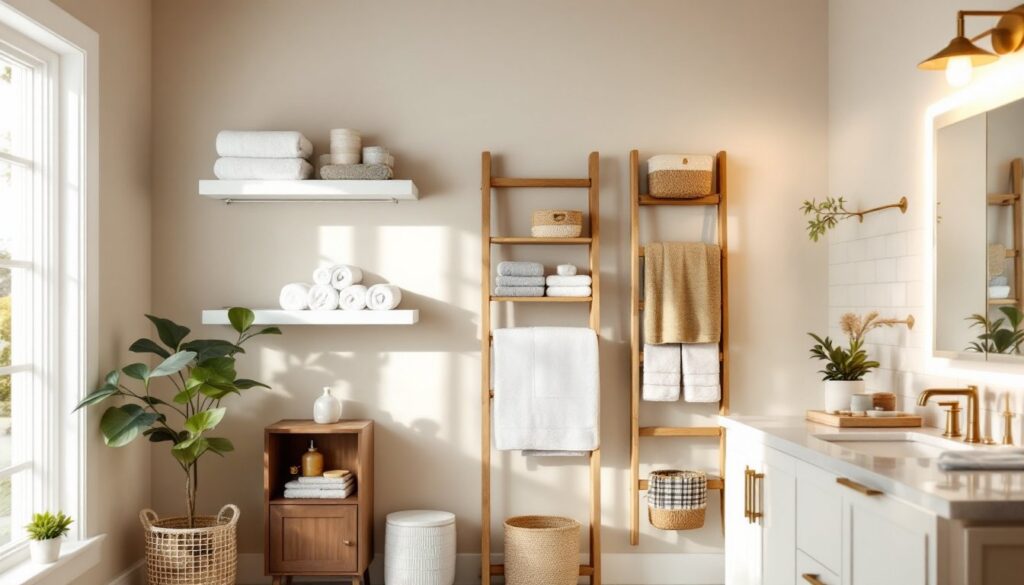
Wall-mounted shelves are the workhorse of bathroom towel storage. A pair of 12-inch-deep floating shelves spaced 18 inches apart holds a full set of bath towels, hand towels, and washcloths in rolled or folded stacks. Floating shelves look clean because brackets mount inside the wall, so hardware stays hidden.
Here’s what matters: find the studs in your walls using a stud finder. Most bathroom vanities sit 36 inches off the floor, so position shelves at 48–54 inches and 30–36 inches for a two-shelf setup. This keeps frequent-use towels within arm’s reach while maximizing height.
Floating shelves need 1/2-inch bolts into studs (or heavy-duty toggle bolts if no stud aligns with your bracket placement, toggle bolts work in drywall alone but drop to about 20–25 pounds per bolt). If you’re storing rolled towels, 3–4 per shelf works without sagging.
A cheaper alternative: open wire shelving from a hardware store doesn’t require as much precision drilling and costs $30–60 per shelf. It’s less fancy but fully functional and easier to adjust if you change your towel stacks later.
Skip the glue-gun-and-string Pinterest projects, simple, sturdy shelves are more practical and age better.
Towel Bars and Heated Towel Rails
A single 24-inch or 30-inch chrome or brushed-nickel towel bar mounted at 54 inches above the floor is the standard in most bathrooms. It’s functional, doesn’t clutter the visual space, and works for both daily towels and guest towels hung separately.
Installation requires a stud finder to locate a wall stud 16 or 24 inches on center. Mount brackets with 3-inch wood screws into studs, never rely on drywall anchors alone for towel bars, which bear constant weight. Aim for studs 30–36 inches apart so both brackets bite solid wood.
Heated towel rails are the upgrade. They cost $150–400 installed and add a small but noticeable energy bill (similar to leaving a light on for 8 hours a day). They’re ideal if you have a bathroom that stays cold or damp. A 400–500-watt rail dries a bath towel in 20–30 minutes and doubles as supplemental heating in winter. Hard-wire them into a dedicated 15-amp circuit (not shared with your bathroom fan or outlets), this may need a licensed electrician and a permit in some jurisdictions.
For renters or those on a budget, a simple bar works just as well. The real key to drying towels is air circulation, not heat.
Ladder Shelves and Freestanding Storage
Ladder shelves and tall, narrow freestanding cabinets are perfect if you can’t or won’t drill into walls. These units stack towels vertically without anchoring, making them ideal for rentals or flexible layouts. A 24-inch-wide, 60-inch-tall ladder shelf holds 12–15 rolled towels and takes up minimal floor space.
When placing one, position it in a corner or against a wall (not the center of the room) so it doesn’t become a tripping hazard. Ladder shelves with 4 or 5 tiers give the most storage: anything taller gets tippy and unsafe. If you have young kids or pets, anchor the back to the wall with a single L-bracket bolted to a stud, a tipped shelf is a safety hazard.
Freestanding narrow bathroom cabinets (18–24 inches wide, 24–30 inches tall) work well beside the toilet or in a corner alcove. These typically cost $150–350 new and last years. Second-hand options from thrift stores or online marketplaces save money and work just as well if hardware is intact.
The advantage of freestanding is flexibility. If you need to move it or repaint the wall behind it, you just lift and shift. The downside is they occupy floor space, measure your bathroom’s layout before committing.
Baskets and Decorative Storage Bins
Baskets and bins are the quiet heroes of bathroom organization. Wire baskets, woven seagrass, or fabric bins mounted on towel rails or wall pegs keep rolled or folded towels corralled and visually soft. A set of 3 stackable wire baskets mounted on a rail holds as much as a small shelf but costs half as much.
Choose breathable materials, woven or wire, so towels don’t trap moisture. Solid plastic bins work for guest towels you rotate less often, but daily-use towels need air circulation. Hang baskets on a rod at 48–60 inches high, or stack them on a low shelf near the vanity for quick access.
Measure the width of your towel rail or wall space before buying. Standard baskets come in 12, 18, and 24-inch widths. A 24-inch rod holds one large basket or two medium ones comfortably.
Fabric drawer organizers work too. Slip them into a vanity cabinet and sort hand towels, washcloths, and guest linens by type. No tools required, and they’re under $30 for a set of three. The trade-off: they’re not as visible, so items stored inside get forgotten more easily. Best practice is to label them.
Corner and Under-Sink Solutions
Corners and the space under the sink are often wasted real estate in bathrooms. A corner shelf unit (triangular or L-shaped) makes use of dead space and draws the eye upward, making small bathrooms feel taller. These mount into a corner with 2-inch screws into studs at both walls and are incredibly stable.
Under-sink storage works for overflow towels or items you don’t grab daily. Before installing a cabinet or shelving unit under the sink, you’ll need to work around plumbing pipes and the drain line. Measure twice, drill once. A simple wire shelf insert (the kind that slides over existing plumbing) lets you stack towels below without permanent installation.
Some people install a shallow pull-out drawer under the sink to store hand towels and washcloths flat. This requires removing the existing cabinet door and adding a drawer frame and slide hardware, a bigger project but gives you more usable depth than just setting shelves.
One caveat: under-sink areas can be damp, especially if there are slow leaks from plumbing connections. Store towels in a breathable container (not a sealed plastic bin) and check moisture levels monthly. If dampness is chronic, you may have a plumbing issue worth investigating before storing anything valuable there.
Design inspiration from sites like Homify shows clever corner solutions for small bathrooms if you’re stuck on layout ideas.
Conclusion
The best bathroom towel storage isn’t the fanciest, it’s what fits your space and keeps towels dry and accessible. Whether you go with wall-mounted shelves, a simple towel bar, or a freestanding ladder shelf, the principle is the same: store towels where they’ll dry quickly and where you’ll actually use them. Start with what you can install today, and add more storage later if needed. Most solutions cost under $100 and take an afternoon or two to complete.